
St. James Parish Criminal Court Records
A criminal court record is the case file kept by the court and clerk once a charge is filed in court. In St. James Parish, that means the criminal side of the Clerk of Court and the 23rd Judicial District Court. The file can show the charge as filed, arraignment, plea, motions, hearing activity, court minutes, disposition, and sentence. It is the record to use when the question is what happened in court.
The sheriff record is different. The St. James Parish Sheriff's Office may hold arrest, booking, offense, crash, body camera, dash camera, public-records request, warrant, and jail custody material. The sheriff public-records notice says criminal offense records are generally privileged until adjudicated, and some investigative material remains restricted unless lawful authority allows release. That limit does not erase the court file, but it changes which office can release which document.
The filed charge itself can be explored in more detail through St. James Parish arrest records and court charge records, while the full court record stays with the clerk's criminal case file.
Search St. James Parish Criminal Records
The official research did not locate a free St. James Parish public portal that searches all criminal court cases. The Clerk of Court's published online records route is LCRAA for conveyance and mortgage records only, so it should not be used as a criminal case portal. For criminal court records, the reliable local route is the clerk's criminal division: 225.562.2389 or 225.562.2271. A request should ask for the court case file, minute entry, disposition, sentence, or certified copy by name and any known case number.
- Confirm that the case is a St. James Parish district-court criminal matter, not only a sheriff arrest or jail entry.
- Collect the defendant name, approximate arrest or filing date, charge name, and any docket or case number.
- Call or write the clerk criminal division and ask which records are available for inspection or copy.
- For court minutes or disposition, identify whether a plea, dismissal, trial, sentence, or other event is being requested.
- For certified copies, confirm copy fees, certification charges, and whether the request must be made in person or by mail.
Use federal systems only when the case is federal. Federal criminal cases for the region use the U.S. District Court for the Eastern District of Louisiana, PACER, and related federal systems, not the parish clerk.
St. James Parish Criminal Case Flow
A criminal court record changes as the case moves. The first filed charge is not the last word. Charges may be amended, reduced, dismissed, or resolved through plea or trial. Court minutes may show an arraignment, counsel appearance, motion setting, bond issue, plea date, trial date, disposition, or sentence. Each entry should be read with date and context, because a later entry can change the meaning of an earlier charge.
Case flow: Charges Filed › Arraignment › Pretrial / Motions › Plea or Trial › Disposition › Sentencing.
At the filing stage, the prosecutor places the charge before the court. At arraignment, the defendant is advised of the charge and enters a plea or receives the next setting. Pretrial entries can include discovery disputes, bond issues, motion hearings, and other legal requests. The case then resolves by plea, trial verdict, dismissal, or another disposition. If there is a conviction, sentencing records the custody, probation, fine, cost, treatment, or other terms ordered by the court.
The manifest assigns the 23rd Judicial District Attorney to this criminal court records page.

The district attorney source matters because the prosecutor is the office that files and prosecutes district-court criminal charges after arrest screening.
What St. James Parish Criminal Records Show
Because no public sample criminal case screen was located from an official St. James portal, the safest field inventory is based on the case-file elements documented in the research. A request to the clerk should name the exact item needed. "Criminal record" can mean a court minute, charging document, plea record, disposition, sentence, bond entry, or certified copy of a judgment. Specific requests are faster and less likely to be routed to the wrong office.
| Field | What It Shows |
|---|---|
| Defendant | The person charged in the criminal court case. |
| Case or docket number | The court or clerk identifier for the criminal file, if known. |
| Filed charges | The formal accusation placed before the court, which may later change. |
| Arraignment and plea | The early court event and the defendant's plea response. |
| Motions and hearings | Pretrial requests, rules, hearing dates, and court action. |
| Disposition | The result of the case or charge, such as guilty plea, dismissal, acquittal, or other outcome. |
| Sentence | Custody, probation, fines, court costs, or other terms ordered after conviction. |
St. James Parish Charges vs Convictions
A charge is an accusation. A conviction is an outcome. St. James Parish criminal court records may show charges that did not result in conviction because they were dismissed, amended, reduced, or resolved in another way. That distinction matters for anyone reading a docket, a court minute, an inmate entry, or a public-records response. A jail roster may show custody status, but it is not a final court disposition search.
| Charge | Conviction | |
|---|---|---|
| Meaning | An accusation filed or pursued in court. | A guilty plea or finding of guilt. |
| Timing | Appears before final case outcome. | Appears after plea or trial result. |
| Record risk | May later be amended, reduced, dropped, or dismissed. | May lead to sentence, probation, custody, or fines. |
Read Dispositions and Sentences
A disposition tells how a charge or case ended. In St. James Parish criminal court records, a disposition could reflect a guilty plea, not guilty finding, dismissal, amended charge, nolle prosequi, acquittal, or other court result. The sentence is the punishment or court order after a conviction. It may include custody, probation, fine, court costs, treatment, restitution, or other conditions depending on the offense and court order.
Read the disposition with the charge and date. A person may have several charges in one case, and each charge can end differently. One count may be dismissed while another count results in conviction. A sentence can also be tied to one count and not another. If the record is needed for court, licensing, immigration, employment review, or another formal use, a certified copy from the clerk is usually more useful than a verbal case summary.
Sealed and Expunged Criminal Records
Louisiana uses expungement law to limit public access to some criminal records. An expungement does not begin by asking the sheriff to remove an entry. It is a court process. The person identifies the arrest date, agency, docket or case number, charge, disposition, and conviction status, then files the correct petition through the district court and clerk. After an order is signed, agencies that hold the record receive the order and apply it under law.
| Sealed | Expunged | |
|---|---|---|
| Public visibility | Access is restricted by court order or law. | Public access is limited under expungement rules. |
| Government access | Some agencies may still have non-public access. | Law-enforcement or court access may remain where law allows. |
| St. James process | Verify the order and case status with the clerk. | File through the 23rd JDC and St. James Parish Clerk of Court. |
The manifest assigns Louisiana Code of Criminal Procedure Article 971 to the criminal court records page.
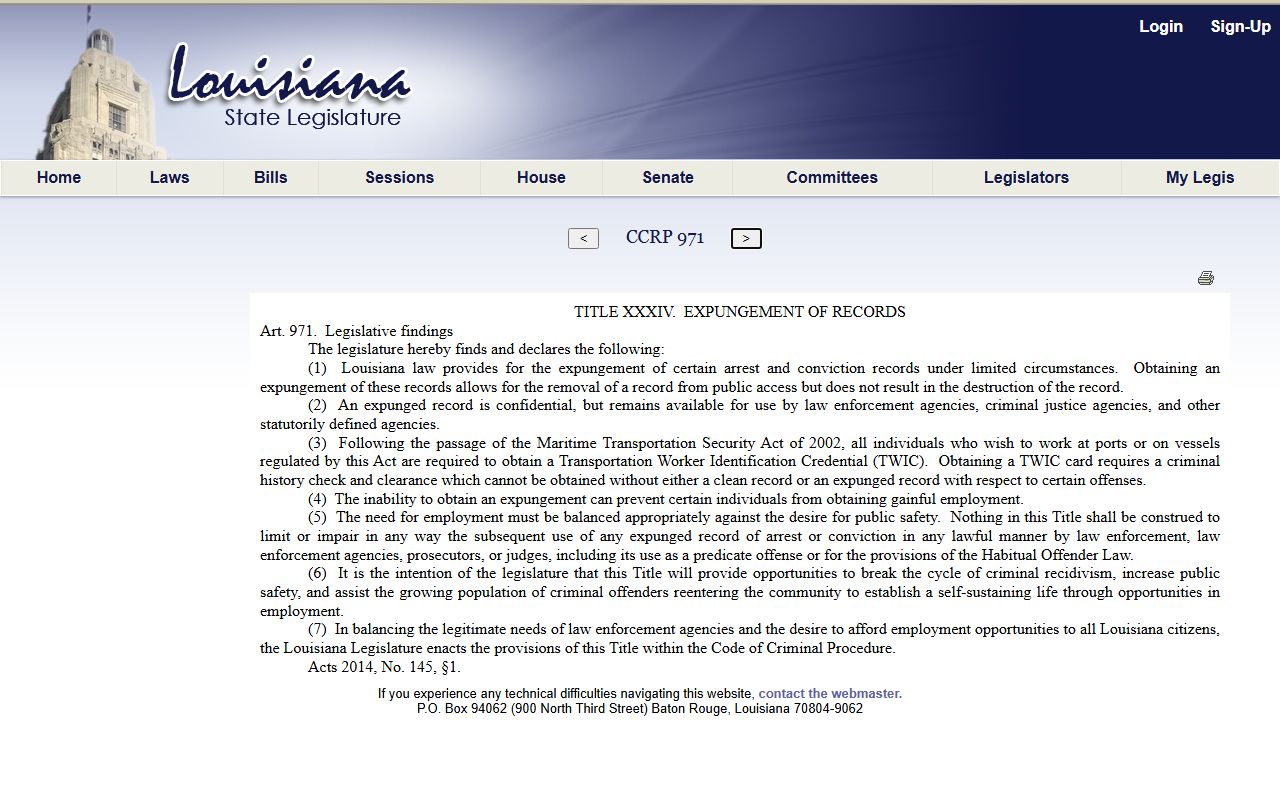
Article 971 provides the definitions used when discussing expungement and public access limits.
Public Access to Criminal Records
Louisiana public records law gives a general right to inspect and copy public records unless a specific law restricts release. For St. James Parish criminal court records, the clerk is the place to start for the court case file. For sheriff offense reports, incident records, crash reports, body or dash camera material, voice recordings, and custody records, use the sheriff public-records process. The sheriff notice states that some criminal offense records are generally privileged until adjudicated, and several categories may remain restricted.
Use the criminal clerk lines for filed criminal case records. Use the sheriff records request route for law-enforcement material. Use the inmate feed only for custody status. These channels can overlap in one real-world event, but they answer different questions. A defendant can appear in a jail feed before a court disposition exists, and a court case can end after jail status has changed.
Key Statutes:
La. R.S. 44:31 gives access to public records unless another law restricts the record.
La. C.Cr.P. art. 976 covers certain misdemeanor expungement circumstances.
The related manifest source also includes Louisiana Code of Criminal Procedure Article 976.
Article 976 is relevant when a requester is trying to understand whether a misdemeanor arrest or conviction may qualify for expungement.
Restricted St. James Parish Criminal Records
Juvenile records, sealed records, expunged records, sexual-offense victim identifiers, confidential sources, undercover officer information, security procedures, investigative techniques, and some training or equipment details may be withheld or redacted. The sheriff also lists juvenile criminal and status-offender identifying reports as restricted. Adoption and some family materials are separate, but the same principle applies: a file category on a fee schedule does not mean full public access to every detail.
Federal criminal records are also separate. The related manifest source includes the U.S. Attorney's Office for the Eastern District of Louisiana.
Federal prosecution records should be checked through federal court and federal agency sources, not through the parish district-court clerk.
Public Record Search
Sponsored Results